Rules & objective
Uses the Monks board and Parker 1938 square Halma rules: 256 squares, 19 each in opposite corners for two, 13 each in all corners for four. The original three-player variant uses 19/13/19 and opposite targets; seats are asymmetric. Choose the first seat; New rotates it. Each turn moves one own piece: step to an empty neighbor in any of eight directions, or hop one adjacent piece of any color in a straight line to the empty square immediately beyond. The same piece may keep hopping, changing direction between hops and stopping at any point. Hopping is optional; do not mix steps and hops in one turn. Jumped pieces remain. Every landing must be legal; entering/leaving camps follows the same movement rules. Clear your starting camp actively so others can finish. Individual play wins by filling the entire target camp with your own army. Opposite seats partner in four-player games. First-army format wins when either partner gets all pieces home. Both-armies format requires both; a finished player may use their turn to move the partner’s pieces. Computer suggestions use only the public board, require confirmation and are not guaranteed best. Our untimed digital convention draws on a third identical board and seat-to-move. Any seat may offer a draw: every other seat must accept; one refusal restores the original turn. Votes consume no move. Board taps and selectors preview the whole route; confirmation commits it. Swipes pan only. Zoom and rotation retain the game and preview. Undo/redo restore real actions; computer undo includes its responses after your last action. Restart restores this setup; New rotates the first seat.
Controls
Arrows:square · Enter:select/confirm · H:hint · U/R:undo/redo · Esc:cancel preview · Stop a hop chain by confirming
Worked example
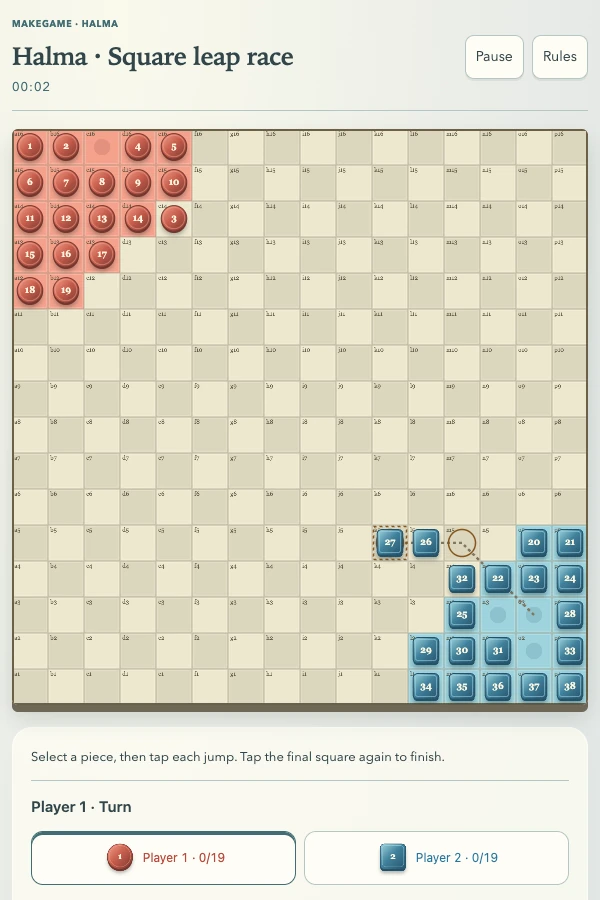
A route may contain several jumps, each landing on an empty square. Jumped pieces stay on the board, unlike peg solitaire.