Rules & objective
Selected Pagat Mexican Train retains personal first-turn chains, later multiple-double extras, oldest-double duties and full13round penalty scoring. Other box versions with single-tile first turns, reverse double order, closing after any play or double0worth50 are not mixed in. Digital agreements: engine-search draws use complete equal batches in a seat order beginning at (round−1) modulo players. If the yard cannot fill a batch, take its last tiles in that order. Confirm the held engine; after a personal first-turn placement you may preview finishing and confirm. First-turn exposed doubles retain actual play order. Round minima describe penalties without awards; tied lowest session totals share victory. A pass cycle alone is not a block: the yard must be empty and every player genuinely unable to make a legal placement, including unresolved double duties. Fresh randomness by default; explicit seeds reproduce deals. No removed tiles, shortened rounds, turn cap, timer or wagering. Draw preview reveals no tile; confirmation adds it privately. Tile selection, hints and finishing the first turn preview until confirmation. Local handoff hides hands; all reveal only at round end. Computer/hints use own hand and public trains/counts only with bounded heuristics, not guaranteed best. Rules/records pause computer. Undo includes its whole response, Redo restores exactly. Restart keeps this round’s deal, engine search and pre-round scores. Next session resets to double12/zero while retaining records.
Use all 91 double-twelve tiles. Deal 15 each for 2–4 players,12 for 5–6,10 for 7–8,8 for 9–10; the rest form the yard. Play 13 rounds, led by double12 down to double0. Its holder places the engine; if nobody holds it, draw equally until found. Play clockwise, beginning with the engine holder’s first turn. Each player may build a chain only on their own train, stopping after at least one tile if desired. No public or opposing train on this first turn. If unable to start, pass without drawing and mark your train open. First-turn exposed doubles wait until everybody finishes their first turn; an empty first-turn hand also waits for everyone before scoring. Later, play one matching tile on your own train, another marked train or the always-public train. A legal tile must be played. Otherwise draw once; play it if possible, else pass and open your train. No repeated draw for that play opportunity. Only playing on your own train closes its marker; playing elsewhere leaves it. A double grants another play anywhere normally allowed; another double grants another, until a non-double or an unplayable draw followed by a pass. After that turn, exposed doubles must be covered oldest first, even on private trains. A last-tile double may go out immediately. Emptying or a genuine legal block ends the round. Everyone adds their remaining pips as penalties; double0 is zero. After all 13 rounds, lowest total wins; scores never end the session early.
Controls
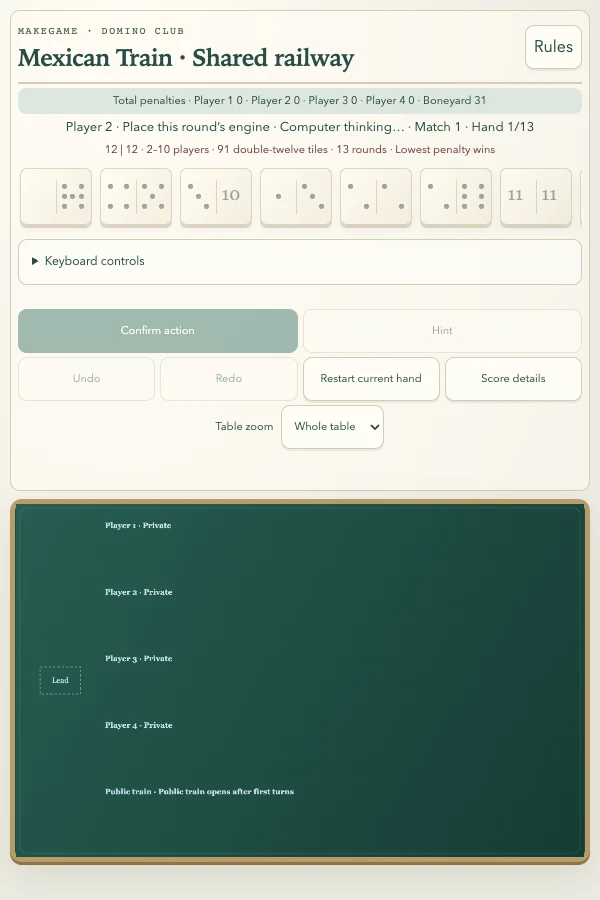
Play directly on the cards or board with mouse or touch. Coordinate selectors are optional keyboard aids.
Worked example
The oldest unsatisfied double constrains the next legal play. You cannot bypass it by placing on another train.